
Twinco Capital: Revolutionising Supply Chain Finance with an ESG Lens
Author
Mundi Ventures
"Twinco Capital is a fintech that provides the first sustainable supply chain finance solution that covers purchase order funding. We pay up to 60% of the value of purchase order up front to the supplier in an emerging market.” Sandra Nolasco , Co-Founder and CEO of Twinco Capital
Watch the full interview with Sandra Nolasco , Co-Founder and CEO of Twinco Capital and Carmen Marin, CFA , Co-Founder and COO of Twinco Capital ➡️➡️ Here.
Twinco Capital: Innovating Supply Chain Finance
At Mundi Ventures, we’re proud to support Twinco Capital, a groundbreaking fintech transforming global supply chain finance.
With offices in both Madrid and Amsterdam by Sandra Nolasco (CEO), a trade finance expert with over 20 years in leading European commercial banks and mother to ten-year-old twins, and Carmen Marin, CFA (COO), who left a senior investment banking role to build this vision while raising four children, Twinco Capital exemplifies innovation and determination. It is the first sustainable supply chain finance solution for retailers such as apparel industries.
Their solutions empower hundreds of suppliers—predominantly SMEs in emerging markets—by providing critical access to funding, enabling growth and resilience within the global supply chain.
Sustainability Challenges in Global Supply Chain Finance
International trade surged in 2021 as countries reopened from the Covid-19 pandemic’s lockdowns and this momentum carried over into the 2022, reaching a record US$32 trillion for the year (Oxford Business Group, 2022). According to the UN trade and development, global trade could reach US$32 trillion again this year despite the supply chain disruption caused the two wars and trade tensions (UNCTAD, 2023).
Global supply chains, especially in industries like apparel, heavily rely on suppliers in emerging markets such as Bangladesh and Pakistan in South Asia. While these suppliers form the backbone of the industry, they often face significant challenges, including limited access to financing and mounting environmental and social accountability pressures. In Asia, the credit access gap is estimated to be $2.5 trillion in 2024 (Mastercard, 2024).
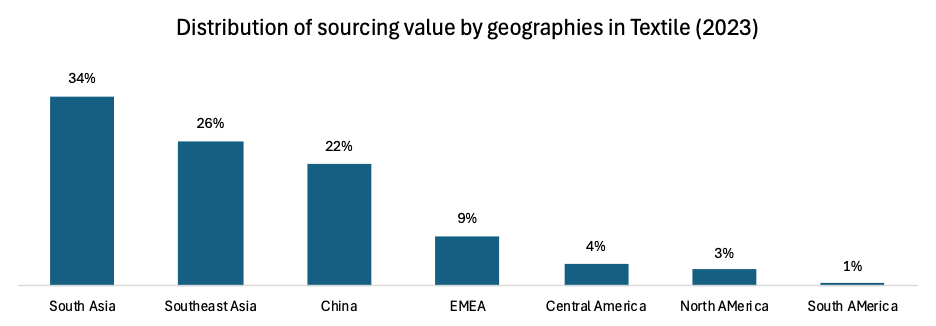
Source: Mundi Ventures based on McKinsey, 2024 (Link)
SMEs in these regions are often forced to choose cheaper, unsustainable raw materials or compromise on labour conditions due to liquidity constraints. Factories may opt for non-organic cotton or fail to invest in cleaner production technologies simply because they lack the financial bandwidth.
However, large corporations are looking to increase the use of sustainable materials as they face increasing scrutiny for the environmental and labour standards of their suppliers. This creates a critical need for a solution that not only funds suppliers but also holds them accountable for ESG (Environmental, Social, and Governance) practices.
